Approx. 6 minutes’ reading time
Increasing inspection frequency, new legal requirements and a growing burden of documentation are making health and safety an ever-greater challenge for safety managers in the manufacturing sector. This article highlights the specific costs incurred by poor occupational health and safety and a lack of ergonomic planning, outlines the regulatory changes that will come into effect in 2026, and explains how digital factory planning tools help to make occupational health and safety predictable, verifiable and, ultimately, audit-ready – before an accident or an official inspection makes this necessary.
Three key findings
- The 5% minimum inspection rate will be legally binding from 2026: Medium-sized manufacturing companies must be prepared for genuine tax audits and need documentation that is audit-ready at all times, rather than just rushing to get it in order before the audit. (1)
- Musculoskeletal disorders are the biggest cost driver: In 2024, they resulted in a loss of value added amounting to 44.2 billion euros in Germany alone. Workstations that are poorly designed from an ergonomic point of view account for a preventable proportion of this. (2)
- Ergonomic improvements made after a system has been commissioned cost many times more than preventative measures: Anyone who only identifies ergonomic risks once operations are already underway will incur the costs of retrofitting, downtime and start-up losses. All of these can be avoided through simulation during the planning phase.
Pressure on safety managers is mounting
Safety managers in manufacturing companies face the same challenges across all sectors. As well as having to constantly prepare for potential inspections and comply with complex regulations, they often lack the necessary time in their day-to-day work. In practice, often around 30 per cent of working hours is spent on documentation, manual data transfers, maintaining spreadsheets and producing reports. These administrative tasks tie up valuable resources, which are ultimately lacking for proactive security work.
Case studies from industry clearly show that these obstacles to the digitalisation of processes are by no means isolated incidents. An ever-expanding regulatory framework can simply no longer be managed using analogue tools. The year 2026, in particular, marks a significant turning point in this development.
Audit readiness can no longer be a one-off exercise. It must become a permanent state.
Regulatory changes in 2026
ArbSchKG: The 5% ratio is enshrined in law
From 2026, government supervisory authorities will be legally obliged, for each calendar year, to to inspect at least 5% of all holdings registered in their country and to carry out checks. This is not a recommendation; it is current law under Section 21(1a) of the Occupational Safety and Health Act (ArbSchG), as laid down in the Occupational Safety and Health Inspection Act (4). For manufacturing companies with known risk potential – particularly in mechanical engineering, the automotive sector and electronics manufacturing – it is to be assumed that supervisory authorities will prioritise inspections of precisely these companies in order to meet their quota.
The next decision on a further increase in the minimum inspection rate is scheduled for as early as 2027. The frequency of inspections will not decrease (3).
What is specifically checked during a site visit:
- Clear definition of responsibilities and order confirmations
- Complete and up-to-date records of training
- Methodologically sound risk assessments
- Evidence of certified work equipment, work procedures and personal protective equipment
- Documentation of the deployment of the health and safety officer and the company doctor
DGUV Regulation 2: New obligations from January 2026
The revised DGUV Regulation 2 came into force on 1 January 2026. It introduces clearer structures and updated requirements: company doctors and occupational safety specialists must Evidence of further training submit this as a standard part of their annual report in future. In addition, the new DGUV Rule 100-002 sets out the implementation requirements in more detail, using practical examples.
For safety managers, this means: Not only must the work be carried out, but it must also be fully documented and verifiable at the touch of a button. Anyone attempting to do this using paper-based systems is exposing themselves to a structural risk (3).
The cost of poor health and safety
Poor ergonomics is not a design problem. It is a cost problem with a clear solution.
Musculoskeletal disorders: the silent wave of costs
In 2024, musculoskeletal and connective tissue disorders caused a loss of value added of 44.2 billion euros in Germany — more than respiratory diseases (41 billion euros) and mental health conditions (38 billion euros). This has hit the industrial sector particularly hard: With a loss of value added amounting to over 70 billion euros Overall, it is the sector most severely affected in Germany (5).
These figures are not merely an economic abstraction. They have a direct impact on the cost calculations of small and medium-sized manufacturing companies: in the form of continued pay costs, costs of finding replacements, the cost of training temporary staff, and reduced production capacity. In 2023, employers in Germany spent 76.7 billion euros on continued pay alone , a figure that has doubled over the past 14 years. Each day of sick leave costs a company an average of 429 euros, comprising lost production and lost value added (5).
Direct costs of an accident at work
In Germany, the following events took place A total of 754,660 reportable workplace accidents in 2024 in the commercial sector. Of these, 9,923 resulted in substantial pension payments or death benefits (6). For a company, every accident at work entails far more than simply continued payment of wages:
- Continued payment of wages for the absent employee (statutory obligation under Section 3 of the EntgFG)
- Loss of production or overtime costs to compensate for this
- Administrative and documentation workload associated with accident reporting and record-keeping
- Increase in BG contributions due to a poor accident record
- Damage to reputation in the event of repeated complaints from supervisory authorities
In 2025, the average labour costs per hour worked in Germany stood at around 45 EUR. Each day of absence due to preventable musculoskeletal disorders therefore costs a company significantly more than just the employee’s wages.
The most expensive cost trap: ergonomic retrofitting after commissioning
The most costly time to discover an ergonomic design flaw is always after commissioning. This results in cumulative costs arising from several sources simultaneously: the cost of modifying machinery and the workstation layout, downtime during the modification process, start-up losses following the modification, and new ergonomic assessments with full documentation.
If the same errors are identified as early as the planning phase through digital simulation, the entire second wave of costs is avoided. This is not merely a theoretical consideration of efficiency; it is the specific key economic levers modern planning software (2).
How ema specifically lightens the Safety Manager’s workload
Ergonomic analysis prior to commissioning
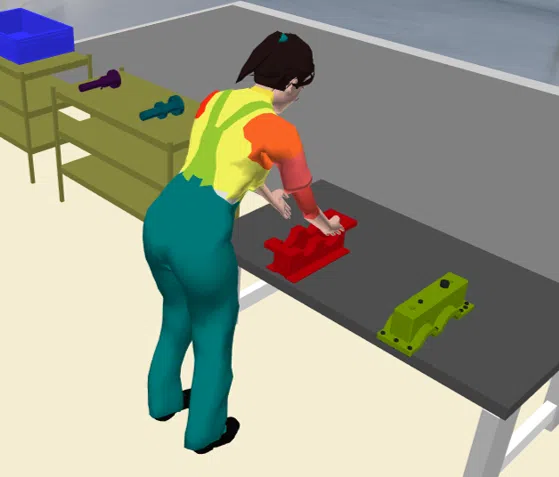
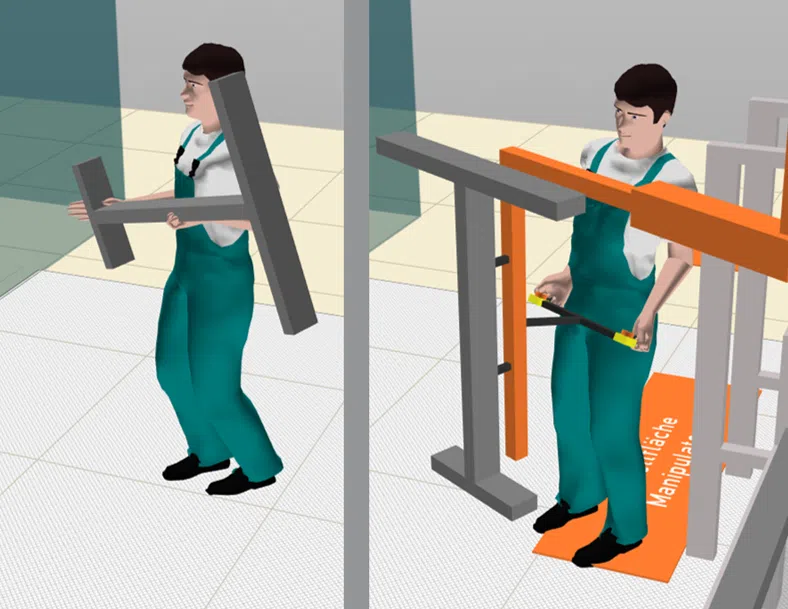
ema integrates recognised ergonomic assessment methods directly into the design process. Ergonomic risks are identified and rectified at the digital model stage, rather than only once the workstation has been physically installed.
For safety managers, this means:
- Early identification of ergonomic risks in a virtual model before construction begins
- Documentable assessment results at the touch of a button, ready for immediate use in risk assessments
- Transparent planning results as the basis for DGUV compliance certificates
- No subsequent refurbishment costs due to poor ergonomic planning
Planning is documentation
The result of an EMA simulation is not merely a technical by-product. It is a structured planning document that can be used directly as supporting evidence for regulatory authorities and the employers’ liability insurance association. Safety managers do not need to draw up separate documentation: The system generates them as part of the planning process.
This addresses a key pain point: around 30% of working time is currently spent on manual documentation maintenance. This expenditure is falling structurally, because digital design data is automatically converted into usable supporting documentation.
Audit readiness as a permanent state
With the 5% minimum inspection rate, audit readiness is no longer just a project issue; it is an ongoing requirement. ema supports this ongoing process through time-stamped planning documents, digital results accessible at the touch of a button, structured record-keeping for risk assessments and a standardised documentation framework for all sites and departments.
The benefits at a glance
Without digital ergonomic planning | With ema |
Ergonomic assessment following commissioning — high follow-up costs | Ergonomic assessment in simulation — cost-effective and carried out at an early stage |
Excel documentation: time-consuming and prone to errors | The planning document also serves as an audit document |
5% – Minimum inspection rate as a structural risk | 5% – minimum inspection rate as a manageable scenario |
MSE risks are dealt with on an ad hoc basis | MSE risks are eliminated as a preventative measure |
Around 30% working hours for documentation | Structural reduction in the documentation workload |
Exam preparation as a sprint just before the exam date | Audit readiness as a permanent state |
Several systems, no shared database | All ergonomics and safety data in a single model |
Summary and conclusion
Poor health and safety is not an abstract compliance risk. It is a Daily running costs absenteeism, continued pay, refurbishment costs and the administrative burden of documentation, which is never fully quantified in most companies. Regulatory developments in 2026, the new DGUV Regulation 2 and the legally binding 5% minimum inspection rate are further increasing the pressure (3).
ema provides safety managers with a tool that enables them to identify, document and rectify ergonomic risks during the planning phase, before the physical environment is actually created. This reduces follow-on costs, lightens the daily documentation workload and makes audit readiness the norm rather than a last-minute measure. Prevention is cheaper than rectification, and with the right digital tools, it is also easier.
Would you like to know just how audit-ready your current health and safety documentation really is? Book a no-obligation consultation with our experts now and see how ema’s ergonomic analysis and documentation can be integrated directly into your planning process.
FAQ
What changes will the new DGUV Regulation 2 bring from 2026?
The revised DGUV Regulation 2 came into force on 1 January 2026. It requires company doctors and occupational safety specialists to submit evidence of continuing professional development as an integral part of the annual report. In addition, the new DGUV Rule 100-002 sets out the implementation requirements in more detail, using practical examples and clear definitions of terms. (3)
What does the 5% minimum inspection rate actually mean for my business?
From 2026, state supervisory authorities must inspect and audit at least 5% of all businesses in their federal state each year. For manufacturing companies with known risk potential, the likelihood of an inspection is very real and continues to rise: a decision on a further increase in the quota is due to be taken as early as 2027. (3)
Which ergonomic methods are integrated into ema?
ema supports the recognised assessment methods EAWS, OWAS and RULA directly within the digital human model. This enables ergonomic stresses to be systematically assessed and documented in accordance with DGUV requirements as early as the planning phase.
How does ema help with exam preparation?
ema generates structured, time-stamped planning documents as an integral part of the planning process. These documents can be used directly as supporting evidence for regulatory authorities and the employers’ liability insurance association, without the need for separate documentation management. As a result, audit readiness becomes a permanent state of affairs, rather than a one-off exercise.
What is the actual cost to businesses of musculoskeletal disorders?
In 2024, musculoskeletal disorders resulted in a loss of value added of 44.2 billion euros in Germany, making them the most costly category of illness of all. The industrial sector bears the heaviest burden of all sectors, with a total loss of over 70 billion euros. Individual companies incur direct costs due to continued payment of wages, the need for cover staff and reduced production capacity. (1)
Who is ema suitable for in the field of health and safety at work?
ema is primarily aimed at safety managers, HSE managers and production managers in medium-sized manufacturing companies with 200 or more employees. The software is particularly relevant for factory refurbishments, new production lines, ergonomic optimisation projects and in any situation where DGUV-compliant documentation must be fully verified.
Are you convinced?
Then get your own free, no-obligation demo version now!
Sources
(1) https://www.ecoprotec.de/mindestbesichtigungsquote-2026/
(2) https://www.physio-deutschland.de/fachkreise/news-bundesweit/einzelansicht/artikel/fehlzeiten-kosten-65-milliarden-euro-mehr-als-46-prozent-der-erwerbstaetigen-in-deutschland-leiden.html
(3) https://forum.dguv.de/ausgabe-4-2021/neues-arbeitsschutzkontrollgesetz-fuer-mehr-sicherheit-und-gesundheit-am-arbeitsplatz/
(4) https://www.eu-gleichbehandlungsstelle.de/eugs-de/experten/newsletter/was-beinhaltet-eigentlich-das-arbeitsschutzkontrollgesetz-
(5) https://www.openpr.de/news/1271510/Die-Kosten-von-Krankheitsausfaellen-in-Zahlen-Wie-Unternehmen-durch-Gesundheitsfoerderung-spa
(6) https://www.dguv.de/de/zahlen-fakten/au-wu-geschehen/index.jsp