Planning errors in manufacturing rarely show up on the profit and loss account (P&L). And that is precisely the problem. This article highlights the hidden costs caused by poor factory planning year after year, explains why these costs are so difficult to quantify, and shows how virtual factory planning makes these cost drivers visible, measurable and avoidable.
Three key findings
- You pay twice for planning mistakes: One for the initial planning, and one for the amendments following commissioning.
- Hidden costs are the most expensive: Layout errors, ergonomic improvements and design revisions arise quietly, without ever being budgeted for as individual items.
- Virtual factory planning turns the tables: Planning software means that errors occur in the digital model, not in reality. This protects profit margins, time and staff.
Prevention is cheaper than cure
Every company that runs manufacturing processes is familiar with this moment: the factory refurbishment is complete, the new production line is up and running, and then the real rework begins. A workstation is ergonomically unsuitable. A material flow is too narrow. A machine is in the way. These situations are not exceptions; they are the norm when factory planning is carried out without digital simulation.
The problem is not that manufacturing companies plan poorly. The problem is that they plan without the right tools. Excel, static drawings and PowerPoint layouts are not planning tools for complex manufacturing environments; they are stopgap measures. And stopgap measures come at a cost.
Any factory refurbishment that is planned without digital simulation ends up costing twice as much: once for the planning, and once for the corrections.
The cost of poor factory planning
Level 1: The visible damage
Unplanned downtime is one of the most quantifiable follow-on costs of poor factory planning. Analyses by ABB and Siemens (1) put the cost of a production stoppage at between 100,000 and 147,000 EUR per hour. For medium-sized companies, the absolute figures are lower, but the relative impact on profit margins is more severe: a single lost hour of production can wipe out the profit margin on an entire order.
Even a conservative estimate makes this clear: a company with a turnover of EUR 20 million that loses just 1% due to avoidable planning shortcomings is spending EUR 200,000 a year without realising it. It may not appear as a separate item on the profit and loss account, but it represents a constant cost burden in operational reality.
Level 2: Information-related damage
Industries that rely heavily on planning lose a significant proportion of their project budgets due to analogue or inadequate planning processes. Studies from comparable planning sectors show that Digital planning methods reduce error costs by up to 57% (2) can, compared with conventional methods.
In production planning, this means, in concrete terms: layout errors, incorrectly dimensioned areas, poorly planned workflows and ergonomic adjustments that are only discovered after commissioning. Such errors are not a quality problem in the traditional sense; they are an information problem. Anyone without validated simulation results is planning on the basis of assumptions.
The strongest cost-related argument in favour of digital factory planning is not the savings it generates. It is the costs it prevents.
The hidden cost drivers
Level 3: What doesn’t appear in the profit and loss account
For CFOs, the real challenge is not the damage that is visible, but the damage that is never quantified. These hidden Cost drivers are constantly at play in manufacturing companies:
- Planning iterations: Processes are planned, discarded and redesigned several times because no validated digital model is available. Each iteration takes up planning time and delays commissioning.
- Misallocated capacity: Machines and floor space are utilised suboptimally because layouts were developed without simulation. The potential of existing resources remains permanently untapped.
- Ergonomic improvements: If workstations are only identified as ergonomically unsuitable after they have been put into operation, this results in refurbishment costs and sickness-related absenteeism, which can exceed the original planning investment many times over.
- Start-up losses during factory refurbishments: Every day that a new production line fails to operate at full efficiency represents a quantifiable loss of revenue, which is rarely identified as a follow-on cost in planning.
- Manual planning time: Planning teams that use Excel, PowerPoint and static drawings spend a considerable amount of staff time on routine tasks that can be largely automated using digital tools.
What virtual factory planning can do, on the other hand
The basic principle: make mistakes virtually, not in real life
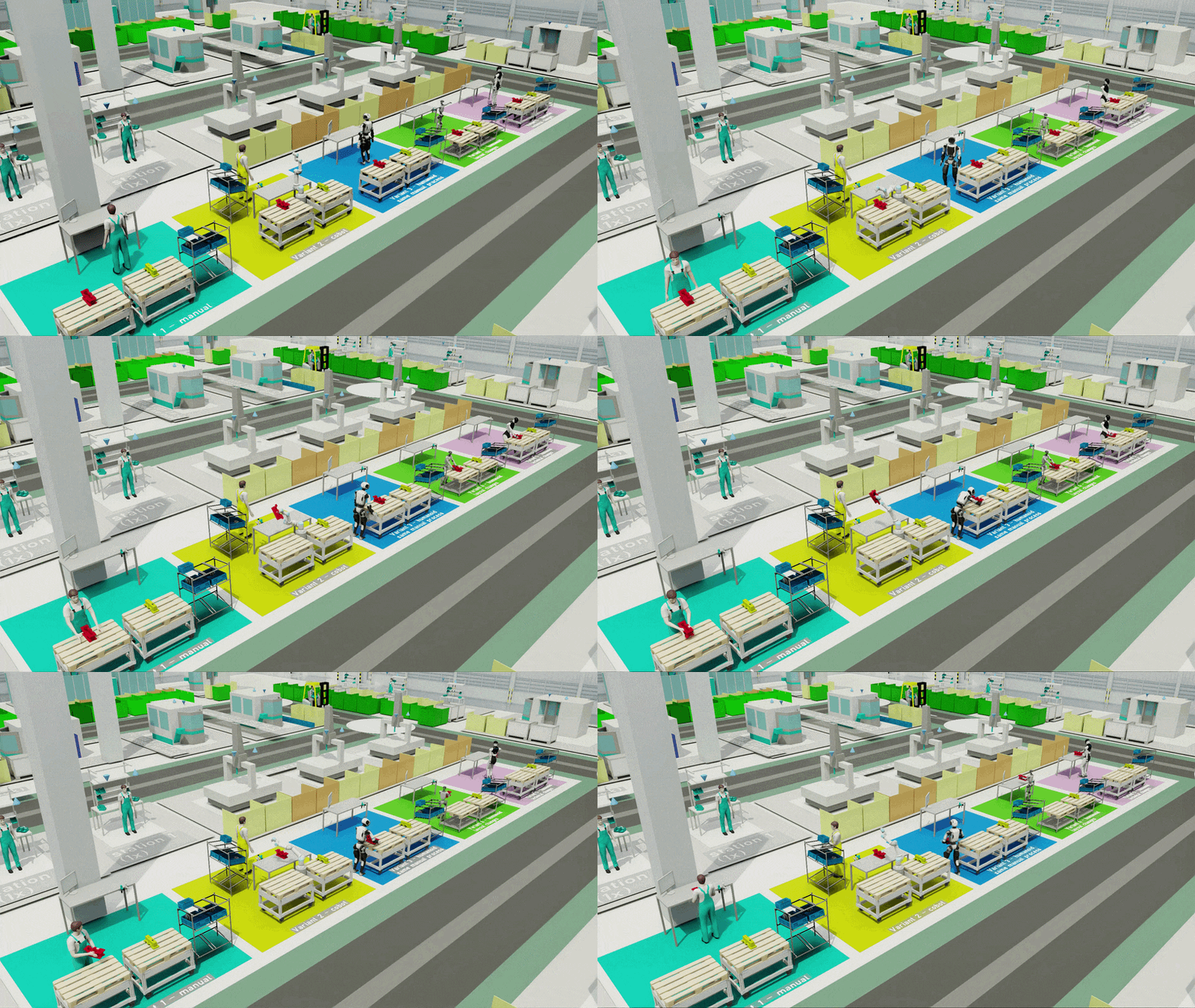
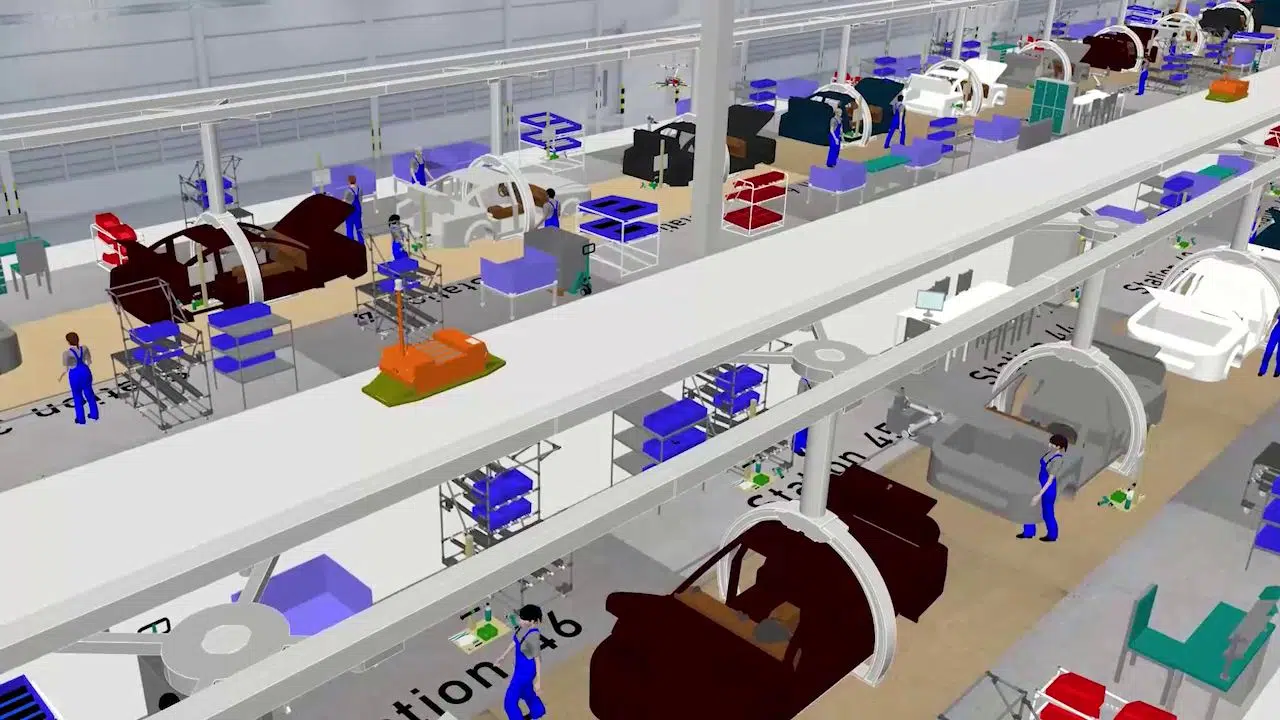
Virtual planning tools make it possible to simulate manufacturing processes and layouts entirely in the digital environment before a single physical change is made. This means that poor planning decisions result in virtual processing costs, rather than actual conversion costs, machine downtime or rectifications during ongoing operations.
This principle sounds simple, but in practice it has far-reaching consequences. After all, the most costly time to discover a planning error is always after the project has gone live. The most cost-effective time is always before the ground-breaking ceremony, and that is precisely where virtual planning comes in.
What this actually means in practice
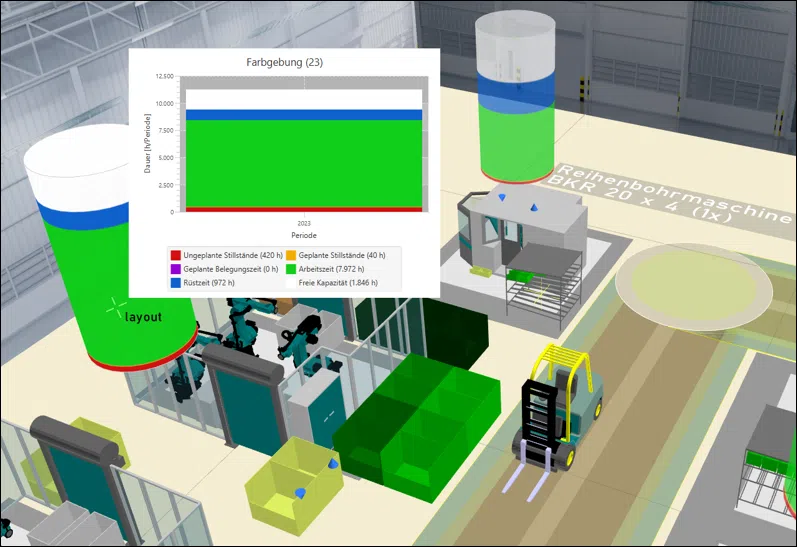
A typical example that users regularly encounter in planning projects: a medium-sized manufacturing company operates a manual feeding station across three shifts, with one dedicated employee per shift. Following an MTM-based process analysis in ema, it transpires that the actual net activity time at this station amounts to merely 30 to 40 per cent of the time spent on site (3). The remaining time is taken up by travel time, waiting time and manual buffer management – all consequences of a suboptimally planned layout. The result: one full-time post per shift is structurally overstaffed. The personnel costs for this single post alone amount to between €130,000 and €160,000 per year across all three shifts. There is no individual item in the profit and loss account, no budget line that identifies this item as „avoidable“, and no traditional controlling tool that automatically highlights this correlation.
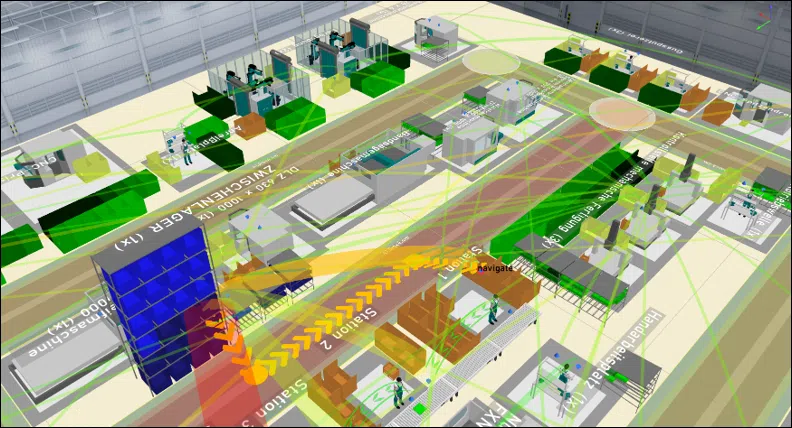
A similar pattern can be observed in the internal transport of materials. Studies on material flow planning show that a production worker covers an average of up to 12 km per day if the layout is not consistently aligned with the material flow (4). Unnecessary transport routes, excessively long distances between linked process steps and poorly positioned buffer areas add up to a permanent loss of productivity, which is directly reflected in increased indirect labour costs and extended lead times. If, on the other hand, the layout is aligned with the actual material flow using ema and simulated, these sources of waste can be eliminated as early as the planning phase, before the first machine is even installed.
What planning software such as the ema Software Suite actually delivers
The results of virtual factory planning using ema can be summarised in four categories:
Time:
- Reducing the need for repeated planning through validated simulation results
- Shorter lead times for factory refurbishments and new production lines
- Fewer coordination loops between production, safety and engineering thanks to a shared digital planning platform
Costs:
- OEE increase from 8 to 15%, with a direct impact on production costs per unit
- Retrofitting costs avoided thanks to layout errors identified at an early stage
- Reduced indirect staff costs through the automated time analysis of manual tasks
Area and resources:
- Optimised use of space through layout simulation before construction begins
- Accurate bills of materials based on the digital model, which reduce procurement costs
Ergonomics and compliance:
- Ergonomic assessments based on recognised methods (EAWS, OWAS, RULA) carried out as early as the planning stage, rather than only after commissioning
- Documented planning results as the basis for DGUV compliance, which can be demonstrated during operational audits
The benefits at a glance
Without virtual factory planning | With ema |
Planning errors end up costing a lot | Errors only cost virtual processing time |
OEE potential remains untapped | An OEE increase of 8 to 15% is achievable |
Ergonomic improvements following commissioning | Ergonomic testing as early as the simulation stage |
Planning iterations due to a lack of data | Validated results from a standardised model |
Traditional planning takes up staff time | Automated time analysis reduces the planning workload |
The hidden costs of errors keep mounting up | Costs become visible, measurable and controllable |
Summary and conclusion
Poor factory planning is not an abstract problem; it is an ongoing cost centre that, in most companies, never appears as a separate item on the profit and loss account. Planning revisions, ergonomic adjustments, sub-optimal use of space and long start-up times are not unavoidable operating costs. They are the calculable follow-on costs of analogue or inadequately digitised factory planning.
Virtual factory planning with ema makes this cost factor visible, quantifiable and avoidable. Companies with a clear ERP and CAD data infrastructure and a specific optimisation project – such as a factory refurbishment or a new production line – typically achieve their first demonstrable results within 6 to 12 months. The greater the current planning inefficiencies, the faster the benefits are realised.
The „return on investment“ (ROI) of ema is not just a question of direct savings. The greatest economic leverage comes from the costs that are avoided in the first place through its use. This is the logic that convinces decision-makers: Prevention is cheaper than cure.
Would you like to know what hidden planning costs your business is incurring? Book a no-obligation demo with our experts now. Together, we’ll analyse your specific situation and show you the efficiency gains that virtual factory planning can deliver for your manufacturing environment.
FAQ
What is meant by virtual factory planning?
Virtual factory planning refers to the complete digital simulation of production layouts, workflows and production processes before any physical changes are made. Errors are identified and rectified in the digital model, rather than after the facility has been commissioned.
Which businesses is ema suitable for?
ema is primarily aimed at medium-sized manufacturing companies in sectors such as the automotive, mechanical engineering, logistics and electronics manufacturing industries. It is ideally suited to factory refurbishments, new production lines or specific efficiency and ergonomics optimisation projects.
When can we expect to see the first measurable results?
Companies with a solid data foundation (ERP, CAD) and a specific use case typically achieve their first demonstrable results within 6 to 12 months.
What sets ema apart from other planning solutions?
ema bridges the gap between simple layout planning (such as vistable) and highly complex material flow simulation (such as FlexSim), which requires extensive modelling expertise. ema delivers reliable, quantifiable planning results without the need for complex IT projects and is the only solution on the market to integrate layout planning, process simulation and ergonomic assessment – including human simulation – within a single platform.
Which ergonomic assessment methods are integrated into ema?
ema supports recognised ergonomic assessment standards such as EAWS, OWAS and RULA right from the planning stage. This ensures that ergonomic workplace requirements and DGUV-compliant documentation can be demonstrably met before the system is commissioned.
Are you convinced?
Then secure your personal, free and non-binding demo now!
Sources:
(1) https://novoai.de/bloggen/blog/manuelle-produktionsplanung-kosten-2025/

(2) https://diewerkbank.eu/de/green-contech-blog/bim-senkt-fehlerkosten-um-57-dennoch-zoegern-viele-planungsbueros

(3) https://boku.ac.at/fileadmin/data/H03000/H93000/H93100/Vortragsreihe_ILT/2021-02-17/ema_Work_Designer_Faehigkeitsgerechte_Gestaltung_Arbeitsplaetzen_Spitzhirn_2021_02.pdf

(4) https://www.vistable.com/de/blog/materialfluss-intralogistik/wie-materialflussplanung-hilft-logistik-produktion-und-lager-zu-optimieren/